17 Aug 2026 · aaoms Team · 2 min read
Why we digitise a logo before the first stitch
The step customers never see is the one that decides whether the logo looks sharp.

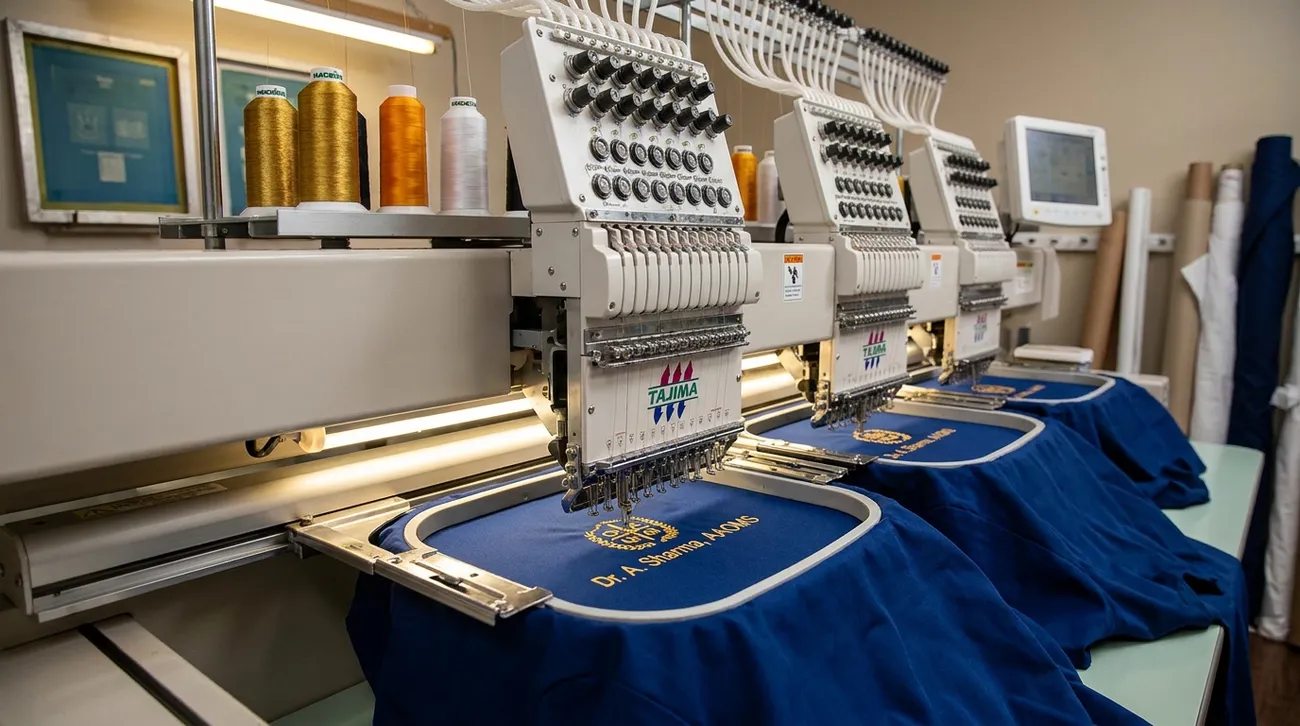
A logo that looks perfect on a screen is not yet a logo that can be stitched. Between the two there is a step called digitising, and it is the difference between a mark that holds for years and one that blurs in months.
Digitising converts an image into a stitch file. It is not a filter or an automatic conversion. Someone has to decide, section by section, how the design will be built out of thread.
Those decisions include the direction of the stitching. A fill that runs across the shape behaves differently from one that runs along it, and on a curved form the wrong direction looks flat.
They include the order of stitching. If an outline is sewn before the fill, the fill will push over it. If a small detail is sewn last, it sits on top and stays legible.
They include the underlay, a light layer of stitches beneath the main design that gives the thread something to hold and stops the fabric from showing through.
And they include the pull compensation. Thread pulls fabric as it stitches, so the finished mark is slightly smaller than the file. A good digitised file is drawn very slightly larger to account for that, and the amount depends on the fabric.
Automatic conversion tools skip most of this. The output stitches, and it usually looks acceptable in a photograph. On a garment worn three times a week, the weaknesses show within months.
This is why we ask for a vector file when you have one, and why we redraw when you do not. A logo in a JPEG is a picture of a logo. Digitising turns it back into something a machine can build properly.
Ask any embroidery supplier whether they digitise in house. The answer explains a lot about the price and about the result.
Need this measured properly?
Send your numbers, or book a call and we will take them with you.